
Introdcution
Walk into almost any photocopy shop near a university campus in Kelaniya, Peradeniya, or Matara, and you will see students paying five hundred rupees for the exact same “Bio-Data” template from 2012. It usually starts with a centered heading in giant bold letters, followed by a table listing their NIC number, religion, marital status, height, and every single O/L grade from ten years ago.
Then they wonder why they send out forty emails across Colombo and never get a single phone call.
I have spent years building local recruitment portals and reviewing thousands of applications submitted by Sri Lankan job seekers—from fresh graduates in Ratnapura applying for bank trainee posts to mid-career engineers in Kurunegala targeting export firms in Biyagama. Most applicants do not get rejected because they lack talent. They get rejected because their CV hides their real value behind outdated formatting and vague sentences.
Here i sharing my personal experiance for how to write a professional CV in Sri Lanka.
Building a CV that actually gets opened and read in Sri Lanka does not require fancy graphic design software or expensive CV writers. It just requires putting the right information in the exact order a busy hiring manager expects to see it.
1. Choose a Clean Single-Column Layout First
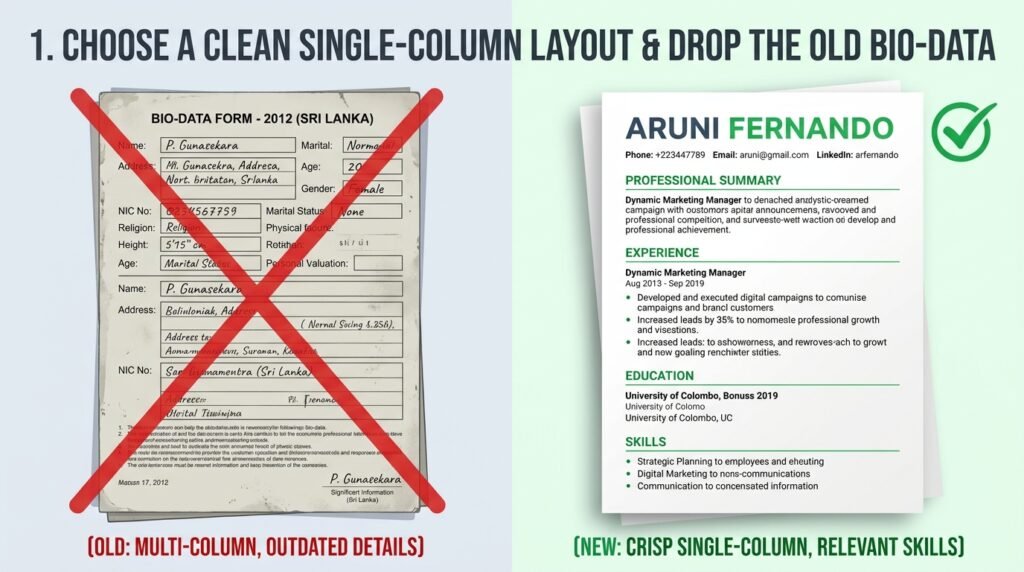
Before typing a single word about your work history, fix your page structure. Many job seekers download colorful two-column templates from Canva with dark sidebars, tiny icons, and little horizontal bars claiming they are “85% skilled” in Microsoft Excel.
Skip those templates completely. Larger companies in Sri Lanka—including banks, telecom providers, BPOs, and IT firms—increasingly run incoming CVs through Applicant Tracking Systems (ATS) or automated folder-sorting tools. Multi-column layouts often scramble your text when software scans the page from left to right. Even in smaller family-owned companies where an HR clerk prints your PDF in black and white, dark sidebars waste ink and look messy on an interview table.
Open a blank Google Doc or Microsoft Word file and stick to these basic rules:
- Font: Use Calibri, Arial, or Segoe UI in size 10.5 or 11 for normal text, and 13 or 14 for section headings.
- Margins: Keep margins around 0.7 to 1 inch so the page breathes comfortably without looking empty.
- Length: Keep it to one page if you are a fresh school leaver or graduate with under two years of experience, and two full pages if you have solid work history. Never spill three lonely lines onto a third page.
- File format: Always save and send your file as a PDF named clearly, such as
Dinuka_Jayasuriya_Supply_Chain_CV.pdf, rather thanNew_CV_Updated(3).pdf.
2. Build a Sharp Header (And Drop the Old Bio-Data)
At the very top of page one, put your full name in bold, followed immediately by four essential contact details on one or two clean lines:
- Current city or town: Writing “Kandy” or “Nugegoda” tells the employer whether commuting to their office is realistic. You do not need your full house number and lane name.
- One reliable mobile number: Make sure it is active on WhatsApp, since many local HR executives send interview location pins via WhatsApp after calling.
- A professional email address: Create a clean Gmail address using your real name instead of an old nickname from school.
- LinkedIn profile URL: Include it if your profile is reasonably updated and matches your CV dates.
Leave out your National Identity Card number, date of birth, gender, religion, marital status, and passport number unless a specific government gazette or overseas recruitment agency explicitly asks for them. Modern private sector employers in Sri Lanka do not want sensitive personal data floating around in shared email inboxes.
3. Write a Three-Line Summary That States Your Exact Value
Skip the tired “Career Objective” paragraph that says you are “seeking a challenging position in a reputable organization where I can utilize my skills for mutual growth.” Every third applicant copies that exact sentence from Google, and recruiters skip right over it.
Replace it with a short Professional Summary that answers three questions in three lines: who you are, what real experience or training you bring, and what problem you can help them solve.
For example, if you are applying for an accounts role:
“AAT-qualified Accounts Assistant with three years of experience handling supplier reconciliations, VAT schedules, and QuickBooks entries for a mid-sized distribution company in Wattala. Experienced in closing monthly ledgers accurately under tight audit deadlines.”
If you are a fresh graduate with zero full-time experience, anchor your summary around your degree, internship, and strongest practical tool:
“BSc Business Management graduate from Sabaragamuwa University with six months of operations internship experience in inventory tracking and Excel reporting. Looking to bring strong data accuracy and customer coordination skills to a logistics or retail team.”
4. Turn Your Work History Into Proof Instead of a Job Description
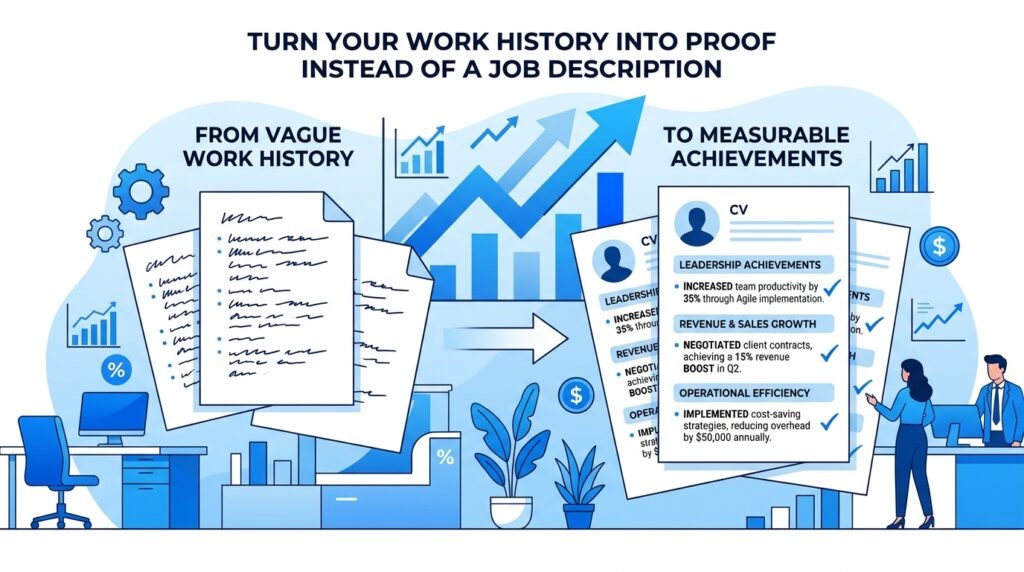
Your work experience section decides whether you get shortlisted. List your roles in reverse chronological order, putting your current or most recent job at the top. For each position, state your Job Title, Company Name, City, and Month/Year you started and left.
If you worked for a smaller regional company that a Colombo recruiter might not recognize, add one short line right under the company name explaining what they do—for example, “Ceylon spice exporter supplying European wholesale buyers.”
Underneath each role, write three to five bullet points. Do not copy lines from your appointment letter. Phrases like “Responsible for handling customer inquiries” or “Assisted with daily warehouse operations” tell the reader nothing about how well you actually worked.
Instead, start each bullet with a strong action verb and attach a real number, system name, or outcome:
- Weak: Managed daily stock sheets and helped with purchasing.
- Strong: Tracked daily stock movements for 350+ hardware SKUs using Excel pivot tables, cutting monthly warehouse variance by 18%.
- Weak: Handled client calls and solved billing issues.
- Strong: Resolved an average of 30 customer billing and delivery queries daily via phone and email, keeping same-day ticket closure above 90%.
Even if you worked part-time at a family business, helped run a campus society event, or completed a short industrial training placement, focus on what improved because you were there.
5. Organize Education and Professional Qualifications Cleanly
Unless you are applying for a fresh graduate trainee intake, place your Education section below your Work Experience. Once you have real workplace experience, employers care far more about what you delivered last year than what grades you scored in school.
List your highest qualification first:
- Degree or Diploma: State the exact qualification name, university or institute (such as University of Moratuwa, SLIIT, NIBM, or SLIATE), and graduation year. Include your class or GPA only if it is strong.
- Professional Bodies: In Sri Lanka, partial or full completion of CIMA, ACCA, CA Sri Lanka, CIPM, CIM, or SLIM carries huge weight. State your exact completed stage clearly (e.g., “CIMA Operational Level Completed”).
- A/L and O/L Results: If you already hold a university degree and three years of work experience, a single line mentioning your A/L stream and school is plenty. Only list individual subject grades if you are a school leaver or fresh intern applicant with limited work history.
6. List Hard Skills That Match the Job Ad
Avoid creating a long bullet list of soft personality traits like “hardworking,” “punctual,” “good listener,” and “team player.” Anyone can type those words on a page.
Create a clean Skills section grouped by practical tools and languages:
- Software & Technical Tools: MS Excel (VLOOKUP, Pivot Tables), QuickBooks, SAP ERP, WordPress, AutoCAD, Canva.
- Languages: Sinhala (Native), English (Fluent written and spoken), Tamil (Conversational).
Read the job advertisement carefully before sending your PDF. If the employer specifically asks for experience with “ERP inventory modules” or “bilingual customer support,” make sure those exact terms appear naturally in your skills or experience bullets so both human readers and scanning software spot them right away.
7. End With Two Non-Related Referees (Not “Available on Request”)
Writing “Referees available upon request” is common in Western countries, yet many Sri Lankan HR departments still expect two named referees right at the bottom of page two so they can run background checks quickly after final interviews.
Choose two people who have directly supervised your work or academic projects—such as a former line manager, branch supervisor, or university senior lecturer. Always call or message them beforehand to ask permission so they are not caught off guard when an HR executive phones them.
Format each referee neatly side-by-side at the bottom of your final page:
- Full Name and Title (e.g., Mr. Chaminda Bandara)
- Designation and Company (e.g., Operations Manager, Lanka Agro Distributors (Pvt) Ltd)
- Direct Mobile Number and Official Email Address
Before hitting send on your application email, print your PDF once or open it on your mobile phone screen. Check that every date aligns neatly on the right margin, confirm there are zero spelling mistakes in your contact details, and make sure your most impressive work sits squarely in the top half of page one. When a recruiter can understand your exact value in ten seconds without squinting, your chances of landing that interview jump overnight.
Summary
Many Sri Lankan job seekers miss out on interviews by relying on outdated “Bio-Data” templates filled with personal details and old exam grades. This step-by-step guide walks applicants through building a modern, ATS-friendly single-column CV tailored for local employers.
It covers structuring a clean header, replacing tired career objectives with a sharp three-line summary, turning routine duties into measurable achievements, highlighting local professional qualifications like CIMA or CIPM, matching job ad keywords, and formatting two non-related referees so recruiters immediately recognize your value.