
A Sri Lankan offer letter rarely tells the whole financial story on page one. You might see a headline number say, LKR 175,000 a month—and expect that exact figure to land in your savings account on payday. It won’t.
Between mandatory retirement deductions, income tax thresholds, and how allowances get labeled on a payslip, two job offers with the exact same gross total can leave you with noticeably different take-home pay and long-term savings. Knowing how local payroll mechanics work protects you during salary negotiations and keeps you from unpleasant surprises when your first payslip arrives.
The Core Building Blocks of a Sri Lankan Payslip
Employers in Sri Lanka split monthly pay into distinct buckets. They do this for tax clarity, overtime formulas, and statutory compliance under local labor laws.
Basic Salary
Your basic salary anchors your entire compensation package. Under the National Minimum Wage of Workers (Amendment) Act, No. 11 of 2025, the national minimum monthly wage stands at LKR 30,000 (or LKR 1,200 daily), absorbing the older separate Budgetary Relief Allowances. Your basic pay cannot fall below this statutory floor—or higher sector-specific floors set by applicable Wages Boards.
Humanised HR & Payroll+ 1
More importantly, your basic salary drives almost every secondary benefit you earn:
- Overtime rates: Under the Shop and Office Employees Act, your normal hourly rate is calculated by dividing your monthly remuneration by 240, with overtime paid at 1.5 times that rate. Humanised HR & Payroll
- Annual leave encashment: Unutilized leave payouts rely directly on your daily wage rate.
- Gratuity: Under the Payment of Gratuity Act No. 12 of 1983, once you complete five years of continuous service at a company employing 15 or more staff, you earn half a month’s last-drawn wage for every completed year worked. Humanised HR & Payroll
If an employer structures an offer with a tiny basic salary padded by massive allowances, your future gratuity and overtime rates shrink dramatically.
Fixed vs. Variable Allowances
Companies attach allowances to cover specific living or job costs. Common line items include Cost of Living Allowances (COLA), transport allowances, fuel reimbursements, meal stipends, and mobile communication allowances.
Not all allowances receive identical legal treatment. That distinction matters when calculating your statutory retirement funds.
How EPF and ETF Actually Work
Every private-sector and semi-government employee in Sri Lanka is covered by two mandatory social security schemes: the Employees’ Provident Fund (EPF) and the Employees’ Trust Fund (ETF). Neither fund caps contributions at a maximum salary ceiling. Whether you earn LKR 45,000 or LKR 950,000, the statutory percentages remain flat.
The Contribution Breakdown
- Employee EPF (8%): Deducted directly from your monthly earnings. This reduces your net cash payout.
- Employer EPF (12%): Paid out of the company’s pocket on top of your salary. Combined with your 8%, a total of 20% goes into your Central Bank-managed EPF account every month.
- Employer ETF (3%): Paid strictly by the employer. Nothing is deducted from your pay for ETF.
Employers must remit both funds by the last working day of the following month—meaning November’s contributions must clear by the last working day of December.
Which Earnings Count Toward EPF and ETF?
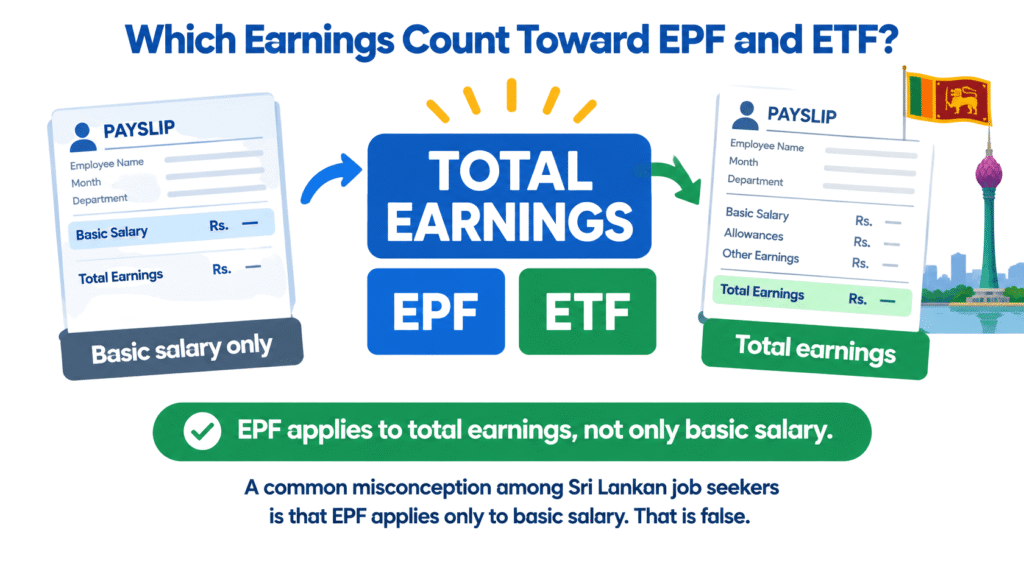
A widespread myth among Sri Lankan job seekers is that EPF applies only to basic salary. That is false. Under the Employees’ Provident Fund Department guidelines and the Employees’ Trust Fund Board, contributions apply to “total earnings”.
Humanised HR & Payroll
| Pay Component | Included in EPF & ETF Base? | Why It Matters |
|---|---|---|
| Basic Salary | Yes | Always forms the core base. |
| Cost of Living / Fixed Living Allowances | Yes | Treated as regular recurring earnings. |
| Regular Food Allowances / Holiday Pay | Yes | Part of standard monthly remuneration. |
| Overtime Payments | No | Explicitly excluded from total earnings under EPF rules. |
| Performance Bonuses & Commissions | No | Irregular incentives sit outside the statutory base. |
| Actual Reimbursable Travel / Fuel Bills | No | Genuine expense reimbursements are not wages. |
Watch out for creative payroll structuring. Some firms label a flat monthly cash payment as a “transport reimbursement” even when you never submit fuel receipts, purely to shrink their 15% combined EPF/ETF employer obligation.
A Practical Sri Lankan Payroll Walkthrough
Numbers make this concrete. Imagine a supply chain analyst in Wattala or a QA engineer in Colombo receiving a monthly package structured like this:
- Basic Salary: LKR 145,000
- Cost of Living Allowance (COLA): LKR 20,000
- Overtime Earned: LKR 15,000
- Reimbursable Fuel (with bills): LKR 10,000
- Total Gross Payout: LKR 190,000
Finding the EPF and ETF Base
Add the Basic Salary (LKR 145,000) and COLA (LKR 20,000). Overtime and verified fuel bills drop out of the statutory retirement calculation.
- Total Earnings Base: LKR 165,000
Calculating Statutory Retirement Funds
- Your EPF Deduction (8% of 165,000): LKR 13,200
- Company EPF Contribution (12% of 165,000): LKR 19,800
- Company ETF Contribution (3% of 165,000): LKR 4,950
Your retirement balances grow by LKR 37,950 that single month, though only LKR 13,200 leaves your pocket.
Checking APIT (Income Tax)
Under Inland Revenue Department (IRD) rules for the 2026/2027 year of assessment, residents enjoy a tax-free personal relief threshold of LKR 150,000 per month (LKR 1,800,000 annually). Unlike EPF, Advance Personal Income Tax (APIT) applies to gross cash remuneration—including overtime and fixed allowances—without deducting your 8% EPF first.
WinCore
Excluding the genuine LKR 10,000 fuel reimbursement, your taxable monthly pay is LKR 180,000.
- The first LKR 150,000 is taxed at 0%. BR.LK
- The remaining LKR 30,000 falls into the 6% bracket.
- Monthly APIT Deducted: LKR 1,800
Final Take-Home Cash
Start with LKR 190,000 gross. Subtract LKR 13,200 (EPF) and LKR 1,800 (APIT). LKR 175,000 hits your bank account.
Offer Letter Verification Checklist
Before signing a new employment contract in Sri Lanka, run through these checks so nothing gets lost in translation:
- Confirm the Basic-to-Allowance Ratio: Ask HR for the exact split between basic pay and allowances, especially if the offer letter quotes a single “consolidated gross” figure.
- Verify “Cost to Company” (CTC) Phasing: Ensure the quoted salary is your gross pay before the employer’s 12% EPF and 3% ETF. Some recruiters quote a CTC figure that secretly bundles the employer’s 15% contribution inside your advertised salary.
- Check Probation Rules: Statutory EPF and ETF apply from your very first day of work—even during a six-month probation period. There is no legal “probation exemption” for EPF or ETF.
- Match Your NIC Details: Confirm that HR spells your full name and National Identity Card (NIC) number exactly as printed on your ID. A single typo freezes your contributions in an unallocated suspense account at the Central Bank.
Sample Email: Asking HR for a Salary Breakdown
If an offer letter only states a lump-sum figure, send a polite, direct note before accepting:
Subject: Salary Structure Clarification – [Your Name] – [Job Title]
Dear [HR Manager’s Name],
Thank you for extending the offer for the [Job Title] role. I am excited about the opportunity to join [Company Name].
Before signing the contract, could you please share the itemized monthly breakdown of the LKR [Quoted Amount] package? Specifically, I would like to confirm:
- The split between Basic Salary and fixed allowances (such as COLA or transport).
- Whether the quoted figure is Gross Pay (subject only to the 8% employee EPF and applicable APIT) or Total Cost to Company inclusive of the 12% employer EPF and 3% ETF.
Thank you for your help, and I look forward to your response.
Best regards,
[Your Name]
[Your Phone Number]