
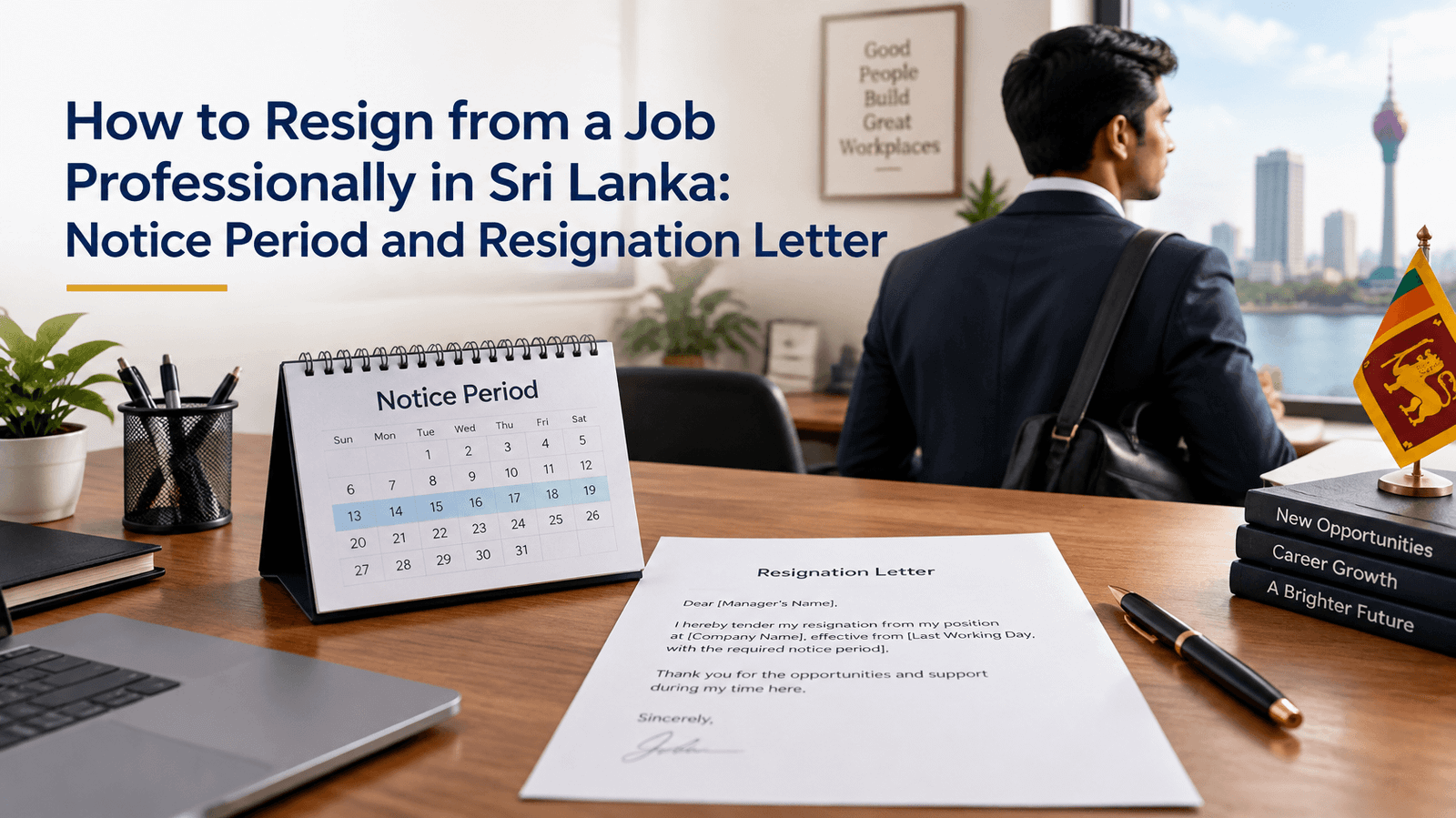
Leaving a job in Sri Lanka involves more than dropping an envelope on a manager’s desk and walking out. Corporate circles in Colombo, Kandy, and Kurunegala are remarkably tight-knit. Your current supervisor might easily sit across the interview table at your next firm three years from now.
Handling an exit poorly can stall your final salary, delay your EPF B-Card, or ruin a reference you will need later. A clean departure protects your legal rights and keeps your professional reputation intact.
What Sri Lankan Labour Law Says About Notice Periods
Many employees assume Sri Lankan statutory law sets a strict 30-day resignation rule. That is a myth.
Neither the Shop and Office Employees Act nor the Wages Boards Ordinance fixes a mandatory number of days an employee must give before quitting. Instead, your signed appointment letter governs the timeline. Under Regulation 15 of the Shop and Office Employees Act, employers must provide written particulars detailing the terms of employment and how the contract can end.
Check your offer letter before picking a final date. Most private sector contracts fall into three tiers:
| Employment Stage | Typical Notice Period | Common Exceptions |
| Probation (First 3–6 months) | 1 week to 2 weeks | Some contracts allow 24-hour notice during probation. |
| Confirmed Junior / Mid-Level Staff | 1 calendar month | Calendar month often runs from the 1st to the 30th/31st, not just any 30 days. |
| Senior Management / Technical Leads | 2 to 3 months | Notice periods are rarely waived without a solid handover plan. |
If your contract says “one calendar month,” timing matters. Handing in your letter on May 15 might legally bind you until June 30 rather than June 14, depending on how your HR team interprets the wording. Read the exact phrasing in your file.
Can You Leave Early or Buy Out Your Notice?
Life happens. Sometimes a new employer in the Port City or an overseas sponsor needs you to start in ten days, not thirty. You have two practical ways to shorten your stay.
First, you can adjust your accumulated annual leave. Under the Shop and Office Employees Act (Department of Labour), employees earn annual holidays based on their start date and tenure. Some companies let you offset unused annual leave against your final days so you stop working earlier while remaining on payroll. Others forbid this and pay out the leave balance in cash instead. Ask HR before assuming you can take your last week off.
Second, you can pay in lieu of notice. If your contract includes a buyout clause, you pay the company your basic salary for the unserved days. Sometimes your incoming employer will cover this buyout cost to get you on board faster. Do not walk out without written sign-off on a buyout; disappearing without approval is treated as vacation of post, which forfeits your service letter.
Breaking the News Before Sending the Letter
Never blindside your direct manager with a formal email out of nowhere. Book a ten-minute slot on their calendar or pull them aside after a morning stand-up.
Keep the conversation direct and calm. State that you have accepted another opportunity and plan to step down. You do not owe anyone a lengthy explanation about salary hikes or frustrations with office politics. Offer a realistic plan for wrapping up your active files. Once that conversation ends, send your written notice the same day so HR has an official timestamp.
Practical Sri Lankan Resignation Letter Templates
Your resignation letter becomes a permanent record in your HR file. Keep it brief, polite, and clear on dates. Avoid airing grievances—save those for an exit interview if you feel comfortable sharing them.
Template 1: Standard Confirmed Employee (1-Month Notice)
Use this format when serving your full contractual notice period.
Date: November 20, 2026
To:
The Manager – Human Resources,
[Company Name (Pvt) Ltd],
[Office Address, e.g., Colombo 03].
Through: [Name of Direct Supervisor], [Supervisor’s Job Title]
Subject: Resignation from the Position of [Your Job Title]
Dear [Supervisor’s Name / Sir / Madam],
Please accept this letter as formal notification that I am resigning from my position as [Your Job Title] at [Company Name]. In accordance with the one-month notice period stipulated in my employment contract, my final working day will be [Last Working Day, e.g., December 19, 2026].
I am grateful for the guidance and opportunities I have received during my time with the team. Over the next four weeks, I will document my ongoing workflows and assist in training my replacement to ensure a smooth transition.
Please let me know the required clearance procedures regarding company assets and final settlement documentation.
Yours sincerely,
[Your Signature]
[Your Full Name]
[Employee ID Number]
[Personal Contact Number]
Template 2: Requesting an Early Release
Use this when you need management to waive part of your notice period.
Date: November 20, 2026
To:
The Head of People & Culture,
[Company Name PLC],
[Office Address].
Through: [Name of Direct Supervisor], [Supervisor’s Job Title]
Subject: Resignation and Request for Early Release – [Your Job Title]
Dear [Supervisor’s Name],
I am writing to formally resign from my role as [Your Job Title], effective today. While my contract specifies a two-month notice period, I kindly request an early release so that my final working day may be [Requested Last Day, e.g., December 18, 2026].
I have already outlined a handover schedule for my current projects and can complete all critical deliverables before that date. Should management require a salary adjustment in lieu of the remaining notice days, I am happy to discuss those terms with HR.
Thank you for your support during my tenure here. I look forward to your confirmation of my release date.
Yours sincerely,
[Your Signature]
[Your Full Name]
[Employee ID Number]
Notice the “Through:” line at the top of both templates. In Sri Lankan corporate and semi-government offices, routing formal letters through your immediate reporting line is standard etiquette.
Your Exit Checklist: Gratuity, EPF, ETF, and Clearance
Resigning triggers several financial and statutory processes. Track these four items before you hand back your staff ID badge:
- Final Salary Payment: Under Section 19(1)(c) of the Shop and Office Employees Act, an employer must pay all earned wages due to a resigning employee before the end of the second working day after termination. Many large companies still process final pay during their regular monthly payroll cycle, so confirm the exact payout date during clearance.
- Statutory Gratuity (5-Year Rule): If you have completed five or more years of continuous service at a company employing 15 or more staff, you qualify for gratuity even when you resign. Under the Payment of Gratuity Act No. 12 of 1983 (Parliament of Sri Lanka), monthly-paid employees receive half a month’s last-drawn basic salary (plus cost-of-living allowances) for every completed year of service. Employers must pay this within 30 days of your exit.
- EPF “B” Card: Resigning does not let you withdraw your Employees’ Provident Fund (EPF) balance unless you meet specific legal grounds like retirement age (55 for men, 50 for women), permanent migration, or marriage (for female employees). However, you must collect your original EPF B-Card (or certified registration record) from HR. You will need it to link your existing member number at your next job or claim funds decades later.
- ETF Claim Eligibility: Unlike EPF, you can withdraw your Employees’ Trust Fund (ETF) balance when resigning, provided five years have passed since your previous ETF withdrawal. Download Claim Application Form VI from the Employees’ Trust Fund Board, fill out your section, and get your employer to certify it before you leave.
Five Habits That Burn Bridges in Sri Lankan Offices
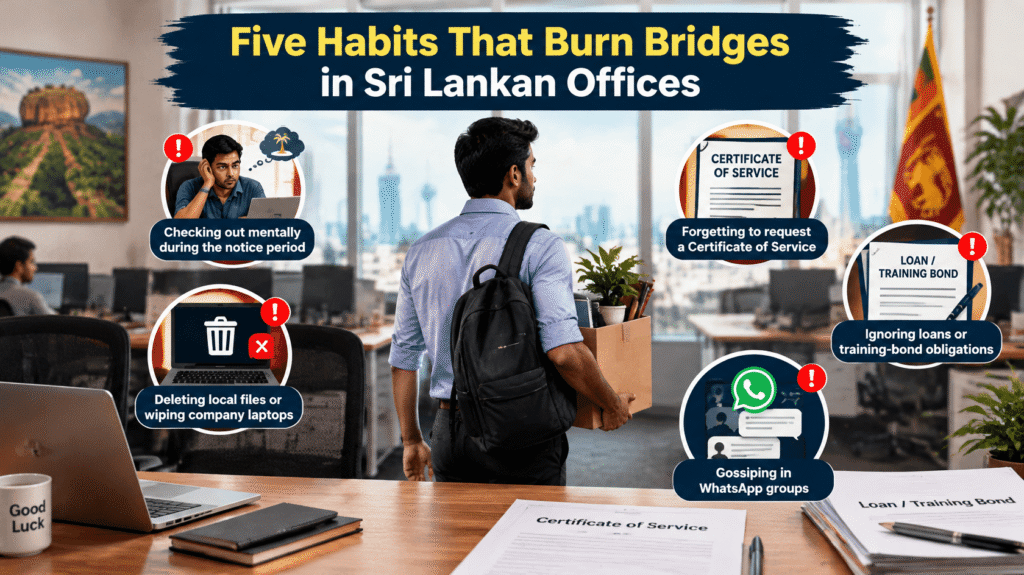
- Checking out mentally on day one of notice: Coasting through your final month forces colleagues to fix your messes after you leave. Finish strong.
- Deleting local files or wiping company laptops: Never wipe work folders, client contacts, or spreadsheets before IT inspects your machine. That can trigger legal trouble over intellectual property.
- Forgetting your Service Letter: Always request a formal Certificate of Service on company letterhead stating your designation and dates of employment. Background check agencies in Sri Lanka rely heavily on this document.
- Leaving loans or bond obligations unaddressed: If your employer paid for a CIMA exam, an MBA module, or a staff loan, check your training bond terms early so the deduction from your final pay doesn’t catch you off guard.
- Gossiping on WhatsApp groups: Screenshots travel fast. Keep your opinions about management offline until your clearance form is fully signed.
Check more Articles: Click here