
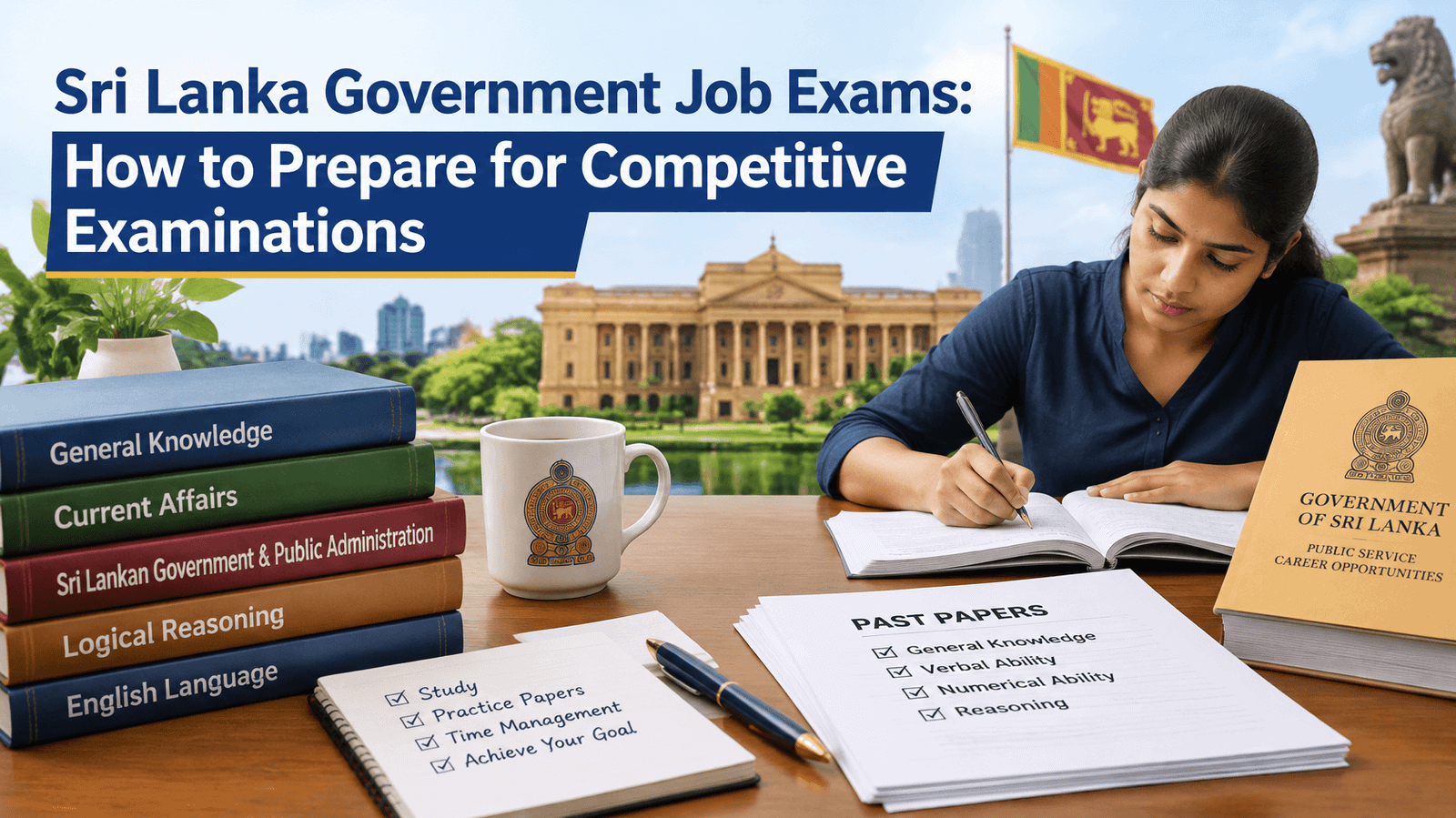
Thousands of graduates and school leavers across Sri Lanka sit for public sector recruitment exams every year, yet only a fraction make the cut-off list. Passing a university degree or earning strong G.C.E. Advanced Level grades rarely guarantees success here. State recruitment tests measure speed, administrative logic, and precision under strict time pressure rather than textbook memorization.
Whether you are targeting the Open Common Competitive Examination for All-Island Services (such as the Sri Lanka Administrative Service, Sri Lanka Accountants’ Service, or Sri Lanka Planning Service) or applying for Management Service Officer (MSO), Grama Niladhari, or Development Officer posts, winning a seat requires treating preparation like a structured campaign.
Decoding the Sri Lankan Competitive Exam Architecture
Before buying a single model paper book outside a Pettah or Kandy bus stand, read the exact Gazette Notification for your post. The Department of Examinations, Sri Lanka conducts most major national recruitment tests, and every Gazette specifies the exact paper structure, language medium rules, and minimum pass thresholds.
Under the Public Service Commission (PSC) framework, major executive intakes—such as the Common Competitive Examination for All-Island Services—often split into two stages:
Public Service Commission
- Part I (The Screening Filter): Usually consists of two mandatory papers: an Intelligence Test (1.5 hours, 100 marks) and a Comprehension paper (2 hours, 100 marks). You must typically score at least 40 marks on each paper and a combined minimum of 100 out of 200 just to qualify for the second stage. TamilGuru.lk
- Part II (Service-Specific Papers): Once you clear Part I, you sit for specialized papers tailored to your chosen service—such as Sri Lankan socio-economic policy, public administration, accounting, or planning. TamilGuru.lk
Non-executive cadres, such as Management Service Officers or provincial clerical grades, normally combine an IQ/Aptitude paper with a General Knowledge and Language Comprehension paper in a single sitting.
Mastering the Core Exam Papers
Most Sri Lankan government exams test four recurring pillars. Study each one differently.
| Exam Paper | What Examiners Actually Test | Smart Preparation Habit |
|---|---|---|
| General Intelligence (IQ) | Number series, spatial patterns, syllogisms, data sufficiency, and basic ratio/percentage math under tight time limits (often 50 questions in 60–90 minutes). | Practice without a calculator. Memorize squares up to 25, cubes up to 12, and fraction-to-percentage shortcuts so you save 20 seconds per question. |
| Comprehension & Précis | Extracting exact facts from dense official paragraphs, summarizing passages within strict word counts, and logical deduction. | Never bring outside knowledge into comprehension answers. Rely strictly on what the passage states, and count your précis words line by line. |
| General Knowledge & Current Affairs | Sri Lankan constitutional basics, provincial council structures, Central Bank economic indicators, sustainable development goals, and major global shifts. | Follow official releases from the Central Bank of Sri Lanka and Department of Census and Statistics rather than unverified social media posts. |
| Administrative & Policy Essays | Structured problem-solving on governance, public finance, rural development, or service delivery. | Write like an administrator, not a university academic. Identify the root bottleneck, cite relevant policy frameworks, and propose practical solutions. |
The “Administrative Tone” Secret in Essay Papers
Many bright graduates fail Part II essay papers because they write emotional, sweeping commentary. Examiners marking SLAS or Planning Service scripts reward balanced, policy-oriented structure. If a question asks about public transport congestion or agricultural supply chains, break your answer into three clear layers: structural causes, institutional/regulatory constraints, and measurable interventions.
A Practical 12-Week Study Schedule
Cramming during the final ten days rarely works because IQ speed and précis writing require muscle memory. Spread your workload across three focused phases:
- Weeks 1 to 4 (Diagnostic & Foundation): Download at least five years of past papers for your target service. Sit one full IQ paper under strict exam timing without looking at the answer key. Note which question types drain your clock—usually seating arrangements, calendar math, or data interpretation tables—and drill those basics daily.
- Weeks 5 to 8 (Topical Grouping & Current Affairs): Group past essay and general knowledge questions by theme rather than by year. Build a compact notebook covering Sri Lanka’s Constitution (especially fundamental rights, the Public Service Commission, and provincial powers), recent national budget priorities, and key macroeconomic indicators.
- Weeks 9 to 12 (Timed Mock Simulations): Every Saturday morning, simulate real exam conditions. Sit at a desk from 9:00 AM to 12:00 PM with only a blue or black pen, an analog watch, and zero phone access. Practice transferring MCQ answers onto bubble sheets cleanly so you never lose marks to misalignment.
Application and Exam-Day Verification Checklist
Even top scorers lose eligibility over avoidable administrative mistakes. Run through this checklist before submitting your online application on the Department of Examinations Online Portal:
- Verify the Gazette Closing Date: Every qualification you claim—your degree effective date, NVQ certificate, or service years—must be valid on or before the exact closing date printed in the Gazette.
- Lock In Your Language Medium: You must sit all papers in the single medium (Sinhala, Tamil, or English) selected on your application. You cannot switch languages inside the exam hall.
- Save Payment Receipts and PDF Confirmations: After paying your exam fee online or via a post office/Bank of Ceylon branch, download the final submitted application PDF immediately. Keep both a digital backup and a printed copy. Doenets.lk
- Check Your Admission Card Signature Rules: When admission cards go live on
doenets.lkroughly two weeks before the exam, print yours early. If you are already a public officer, your Head of Department must attest your signature on the admission card before exam day. - Carry Valid ID to the Hall: Bring your original National Identity Card (NIC), valid Passport, or valid Sri Lankan Driving Licence. Photocopies or expired temporary slips will get you turned away at the gate.
Sample Précis & Administrative Answer Approach
In Comprehension papers, candidates frequently lose easy marks by ignoring word limits. If a question asks you to summarize a 280-word passage on rural digitalization into 70 to 80 words, draft a rough grid first:
Drafting Rule of Thumb:
- Sentence 1 (Core Theme): State the central policy objective in under 20 words.
- Sentences 2–3 (Key Mechanisms & Challenges): Combine two supporting facts into single concise clauses without copying full sentences verbatim from the text.
- Sentence 4 (Outcome): State the intended result in under 15 words.
- Final Count: Tally every article (a, an, the) and preposition. Landing at 74 words hits the sweet spot safely inside the 70–80 word bracket.
Frequently Asked Questions
Can final-year university students awaiting degree results apply for graduate-level government exams?
Usually, no. Unless a specific Gazette explicitly states otherwise, the effective date of your degree must fall on or before the application closing date. If your university Senate approves your results after the closing date, the interview board will disqualify your application even if you pass the written exam.
Is there negative marking in Sri Lankan government MCQ papers?
Most competitive examinations conducted by the Department of Examinations—including SLAS, MSO, and banking trainee aptitude tests—do not apply negative marking for wrong answers. If you have 30 seconds left on the clock and five unanswered multiple-choice questions, fill in your best logical guess rather than leaving blanks.
What is the difference between an “Open” and a “Limited” competitive examination?
An Open Competitive Examination is open to all eligible Sri Lankan citizens who meet the age and educational criteria (for example, external graduates aged 22–30 applying for SLAS Grade III). A Limited Competitive Examination is restricted strictly to confirmed officers already serving inside the public sector who have completed a required number of years of satisfactory service and hold a clean disciplinary record.
Conclution
Passing Sri Lankan public sector recruitment exams—from the Common Competitive Examination for All-Island Services to Management Service Officer and Grama Niladhari posts—requires strategic preparation rather than rote memorization. This guide decodes the Department of Examinations’ multi-stage exam architecture, core test pillars (IQ, comprehension, general knowledge, administrative essays), 12-week study frameworks, and crucial application checklists.