
Joining the Sri Lanka Teachers’ Service (SLTS) remains one of the most respected career routes on the island. Unlike corporate jobs where hiring happens quietly through LinkedIn referrals, state school appointments follow strict legal pathways governed by the Ministry of Education, the Public Service Commission (PSC), and the nine Provincial Councils.
Many qualified graduates and school leavers miss out simply because they apply under the wrong category or misread a single sentence in a Gazette notice. Understanding the exact entry grades, subject-matching rules, and exam stages helps you prepare your paperwork before the next recruitment window opens.
The Three Main Entry Pathways into Government Teaching
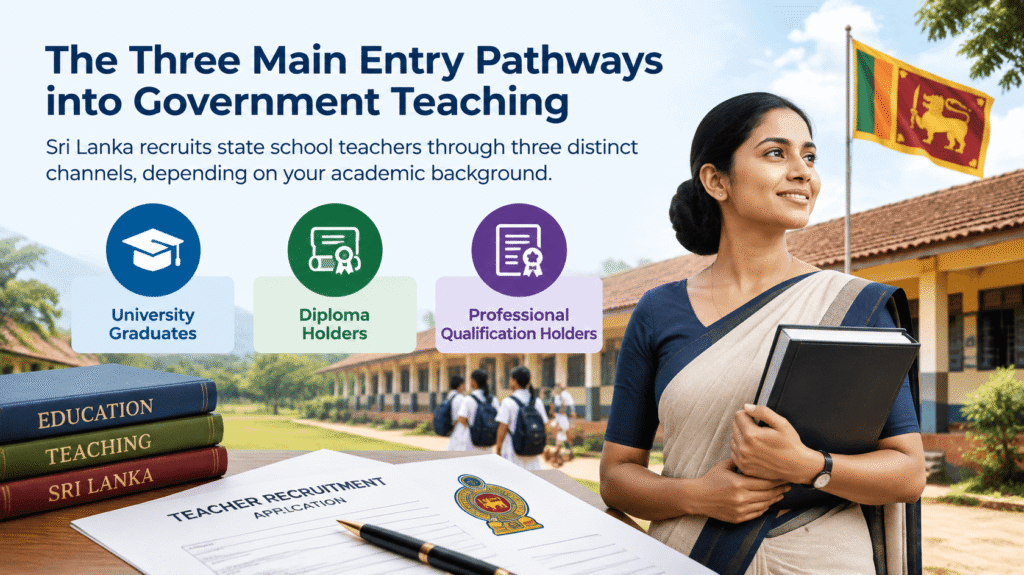
Sri Lanka recruits state school teachers through three distinct channels, depending on your academic background.
| Entry Route | Required Qualification | SLTS Entry Grade | Selection Method |
|---|---|---|---|
| National Colleges of Education (NCOE) | G.C.E. A/L passes (selected via Z-score merit lists) | Class 3 – Grade II | 3-year residential & internship program leading to the National Diploma in Teaching. |
| B.Ed. Degree Holders | Bachelor of Education from a UGC-recognized university | Class 2 – Grade II | Direct recruitment notices (national or provincial) followed by structured interviews. |
| General / Special Graduates | BA, BSc, BCom, or specialized degrees from a recognized university | Class 3 – Grade I (A) | Open or Limited Competitive Written Exam + Interview & 5-minute Practical Teaching Test. |
1. National Colleges of Education (Vidyapeetha)
For school leavers right after G.C.E. Advanced Levels, entering a National College of Education is the most structured path. Selection relies strictly on A/L Z-scores and district quotas published in the annual Ministry of Education Gazette. Trainees complete two years of full-time residential study followed by a one-year school internship before receiving permanent appointments.
GovInfo.lk+ 1
2. Bachelor of Education (B.Ed.) Graduates
Because a B.Ed. combines academic subjects with pedagogy and classroom training, graduates enter one step higher on the service ladder—typically Grade 2-II of Class 2. Appointments still require an official vacancy call from either the line Ministry (for National Schools) or a Provincial Ministry of Education (for Provincial Schools).
GovInfo.lk
3. Open and Limited Graduate Recruitment
Holders of non-education degrees (such as a BSc in Physical Science from Kelaniya or a BA in Economics from Peradeniya) enter at Class 3 – Grade I (A). State intakes usually split into two tracks:
BrightNook.lk
- Open Competitive Examination: For external graduates (typically aged 18–35, occasionally extended to 40 via special Gazette provisions).
- Limited Competitive Examination: Reserved for confirmed public officers—such as Development Officers already attached to schools or divisional secretariats—who hold valid degrees.
Crucial Eligibility Rules That Catch Applicants Out
Before filling out any form, verify four strict conditions printed in the SLTS Service Minute:
- The “One-Third Subject Content” Rule: You cannot apply to teach A/L Chemistry or O/L History just because you took one introductory module in your first year. Under SLTS Gazette provisions, your degree transcript must prove that the relevant subject accounted for at least one-third (1/3) of the total course content of your three-year or four-year degree.
- G.C.E. O/L Language Requirement: Every applicant—even an English-medium IT or Mathematics graduate—must have passed Sinhala or Tamil at the G.C.E. Ordinary Level examination.
- Provincial Residency Rules: National Schools are managed by the central Ministry of Education, whereas roughly 96% of Sri Lankan schools fall under Provincial Councils. To apply for a provincial vacancy (for example, in Sabaragamuwa or the Southern Province), you generally must prove three years of continuous permanent residency in that province prior to the closing date—or one year if applying through your spouse’s three-year provincial residency. Southern Provincial Ministry of Education
- Effective Date of Qualifications: Your degree results must be officially valid on or before the exact closing date specified in the Gazette. A pending final semester result disqualifies you at the interview table. BrightNook.lk
Inside the Competitive Examination and Practical Test
When the Department of Examinations conducts the graduate teacher recruitment exam, candidates sit for two written papers:
- Paper I – Intelligence Quotient (IQ): Tests logical reasoning, number sequences, spatial patterns, and quick numerical problem-solving under strict time limits.
- Paper II – General Knowledge & Education Aptitude: Focuses heavily (often up to 90%) on the Sri Lankan education system, child psychology, classroom assessment methods, national education reforms, and current affairs. Lanka Past Papers
The 5-Minute Practical Teaching Demonstration
Passing the written test moves you to the provincial or ministry interview board, which includes a mandatory 5-minute practical teaching test.
Panelists act as students while you teach a micro-lesson on a topic from your subject syllabus. Examiners do not expect you to finish an entire chapter in five minutes. They score how clearly you state the lesson objective, how naturally you use the whiteboard or visual aids, whether you check student understanding, and how calmly you manage classroom voice projection.
Step-by-Step Application Process
Modern teacher recruitments—both at the national level and through provincial portals like Sabaragamuwa or Western Province—have largely shifted to online portals alongside registered-post backups.
- Verify the Exact Gazette Number: Download the official PDF from the Department of Government Printing or the Ministry of Education website. Never rely on cropped WhatsApp graphics for subject codes.
- Match Your Subject Code and Medium: Confirm the exact numeric subject code (for instance, Science, ICT, Primary Education, or English) and medium (Sinhala, Tamil, or English). You can usually list up to two or three subject preferences in order of priority. Sabaragamuwa – Ministry of Education+ 1
- Pay the Exam Fee: Settle the prescribed fee through the online payment gateway or at a designated Bank of Ceylon / Post Office counter, keeping the receipt number safe.
- Submit the Online Application & Print Two Copies: Enter your NIC number, O/L and A/L index numbers, and university degree validity date carefully. Download the generated PDF immediately. If you are already a government employee (such as a Development Officer), route a printed copy through your Head of Department before the deadline. Sabaragamuwa – Ministry of Education
- Track School Preference Lists: For national intakes, shortlisted candidates who pass the interview log back into the Ministry portal using an OTP sent to their mobile number to rank preferred schools with active vacancies.
Document Verification Checklist for Interview Day
Arrange these originals—plus one set of certified photocopies—in a neat folder before your interview date:
- National Identity Card (NIC) and Original Birth Certificate.
- Official G.C.E. O/L and A/L Certificates issued by the Department of Examinations (website result sheets are rejected).
- Degree Certificate and Detailed Academic Transcript showing your subject breakdown and effective date. Foreign or private degree holders must attach a University Grants Commission (UGC) recognition letter.
- Grama Niladhari Residency & Character Certificate, countersigned by the Divisional Secretary (essential for proving provincial residency).
- Lesson Plan & Teaching Aids prepared specifically for your 5-minute practical demonstration.
Frequently Asked Questions
Can I apply for a government teaching job in English medium if I studied my degree in Sinhala or Tamil?
Usually, no—unless the specific Gazette explicitly allows candidates who hold a separate English teaching qualification or an A/L/O/L distinction in English to bridge the medium gap. In standard graduate recruitments, your degree must have been completed in the exact medium you apply to teach, or you must hold a recognized English specialist qualification listed in the Gazette schedule.
Once appointed, how many years must I serve in my first school before requesting a transfer?
Under national teacher transfer policies, newly appointed teachers are generally required to serve a mandatory initial period—commonly three to five years, especially in difficult or rural school categories—before becoming eligible for a routine annual transfer to a more popular urban school.
Do I need a Postgraduate Diploma in Education (PGDE) before applying?
No. A PGDE is not required to enter Class 3 – Grade I (A) as a graduate teacher. However, once appointed, completing a PGDE through the Open University of Sri Lanka (OUSL), the National Institute of Education (NIE), or a state university is mandatory for your future promotion to Class 2 and higher grades.
What happens if I apply to both a Provincial Council vacancy and a National School vacancy at the same time?
You are legally permitted to apply for both if you meet the residency and subject criteria for each Gazette. If you pass both exams, you will simply choose which appointment letter to accept when offers are issued, though you cannot hold two public service appointments simultaneously.