
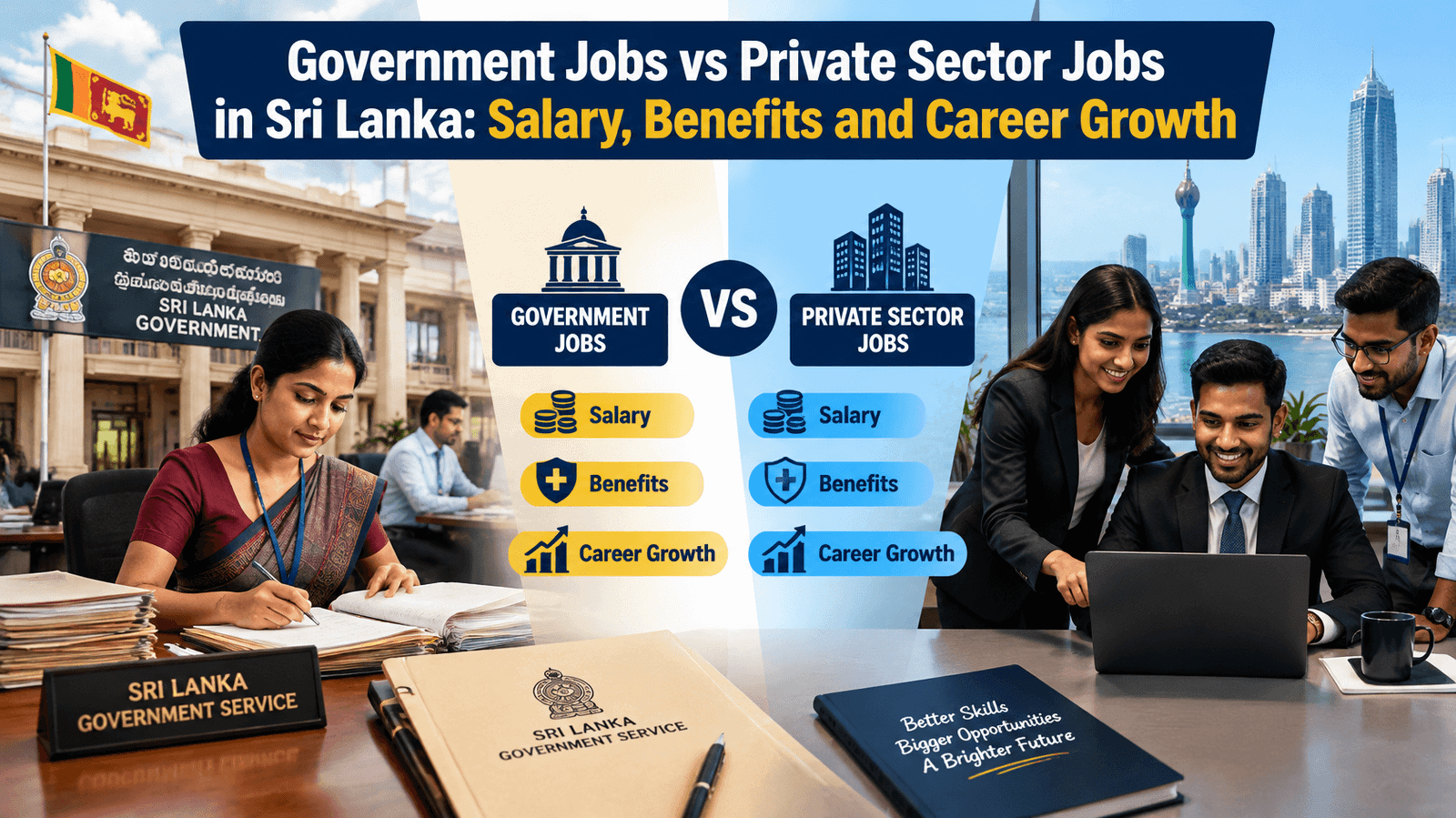
Pick any family dinner table in Matara, Galle, or Trincomalee and you will hear two competing versions of career wisdom. One auntie swears a kaccheri or school teaching post is the only safe anchor in a stormy economy. Your cousin working in fintech or apparel exports in Katunayake or Colombo 03 will tell you that waiting years for a government increment leaves real money on the table.
Both sides hold real truths. Choosing between a state role and a private-sector job in Sri Lanka isn’t just picking a paycheck. It is deciding how you want your income, retirement, daily stress, and skill set to evolve over the next twenty or thirty years.
How Pay Works in Both Worlds
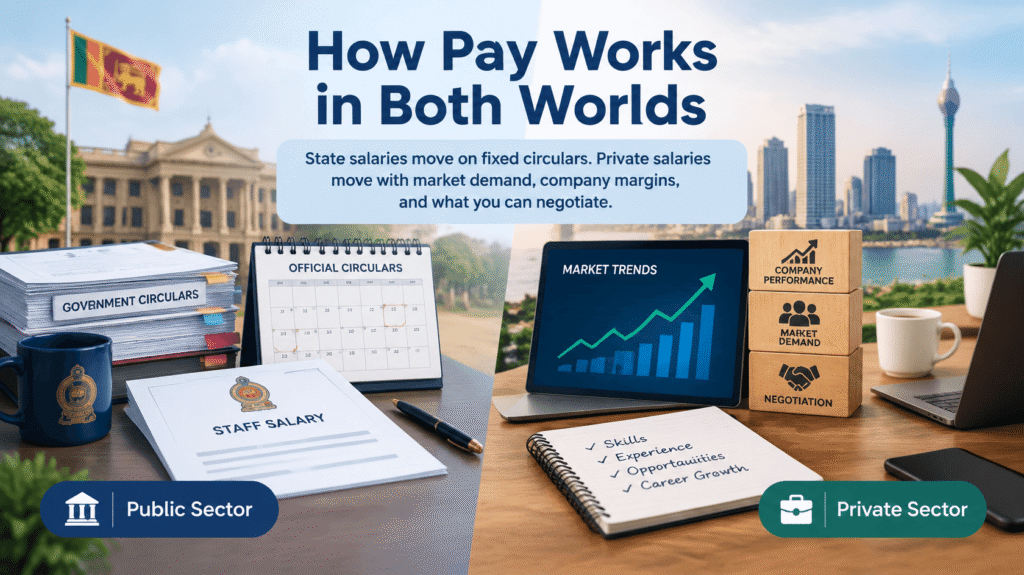
State salaries move on fixed circulars. Private salaries move with market demand, company margins, and what you can negotiate.
In the public service, pay grades follow structured scales issued under Ministry of Public Administration circulars. Following the salary revision implemented from January 1, 2025 under Public Administration Circular 10/2025, entry salaries vary sharply by service code.
A starting Management Assistant (MN 1) begins around Rs. 45,230 per month, a teacher in service grade GE 1 starts near Rs. 53,060, and an executive-grade officer (SL 1) starts around Rs. 82,150 before applicable allowances and annual step increments. The upside is predictability. You know roughly what your base pay will look like in three or five years if you pass efficiency bars and move up service steps.
Private sector pay is a wide spectrum. A junior accounts clerk at a trading house in Pettah or a customer support executive in Kandy might earn roughly similar starting cash to a clerical officer, though performance bonuses or overtime can lift the total.
Meanwhile, a mid-level software engineer, quantity surveyor, or supply-chain specialist at an exporting firm or multinational in Colombo can earn several times more than a mid-tier state officer. Pay rises in the private sector often come from switching employers or taking on expanded revenue-facing roles rather than waiting for a scheduled annual increment.
Cost of living adds another wrinkle. A Rs. 90,000 salary stretches very differently in Anuradhapura or Ratnapura than in Nawala or Dehiwala, where rent, school transport, and commuting eat up cash fast.
| Dimension | Government Sector | Private Sector |
|---|---|---|
| Pay Structure | Standardized salary scales and service codes; predictable step increments | Market-driven; negotiable pay, bonuses, and commissions |
| Retirement Security | Non-contributory state pension (subject to scheme rules and service eligibility) | EPF (8% employee + 12% employer) and ETF (3% employer) |
| Job Security | High protection once confirmed; difficult to dismiss without formal disciplinary inquiry | Tied to company performance, restructuring, and contract terms |
| Promotion Pace | Seniority, service exams, and cadre vacancies often set the speed | Merit, output, and market mobility can move you faster |
| Work Hours & Flexibility | Set office/shift hours; transfer rules can move you across districts | Often longer hours or project sprints; hybrid work common in tech/corporate |
Retirement, EPF, ETF, and Day-to-Day Benefits

People often compare gross pay and forget what disappears or compounds behind the scenes.
Private-sector employees are covered by statutory retirement funds overseen through the Department of Labour and the Central Bank. Every month, employees contribute a minimum of 8% of total earnings to the Employees’ Provident Fund (EPF) while employers contribute at least 12%, plus 3% to the Employees’ Trust Fund (ETF). Your EPF is a lump-sum pot that earns interest and can be claimed under qualifying conditions (such as retirement age—55 for men and 50 for women—permanent migration, or other statutory grounds), whereas ETF offers periodic withdrawal eligibility rules and benefits.
Good private employers also throw in medical insurance, fuel or mobile allowances, annual performance bonuses, and sometimes staff loans.
Government employees generally do not rely on EPF/ETF in the same way for core pensionable posts; instead, public service pensions provide lifelong monthly income after qualifying years of service. Public-sector compulsory retirement is set at age 60 under gazette rules (with specific statutory exceptions), while state-owned enterprises operate under specific optional/compulsory retirement rules. For someone who hates market risk and wants a steady monthly pension later in life, that matters a lot. For someone who wants a lump sum to invest, start a small business, or fund children’s education, a well-managed EPF/ETF nest egg plus personal savings can work well—provided your employer actually remits contributions on time.
Leave and daily rhythm differ too. Public sector jobs usually offer clear leave entitlements, fixed holidays, and less weekend firefighting—unless you work in healthcare, policing, ports, or disaster response. Private offices demand faster turnarounds, tighter KPIs, and occasional late nights when a client deadline or shipment is on the line.
Career Growth, Transfers, and Long-Term Mobility

Career growth in the state sector looks like climbing a sturdy ladder with clear rungs. You sit for competitive exams, complete service minutes or training, clear efficiency bars, and wait for cadre openings. Transfers are part of the deal. A divisional officer or teacher might get posted far from home, which tests family life, though transfers can also bring you closer to home later.
In the private sector, growth is less linear and more lumpy. You might stay at one company for four years with modest bumps, then jump to a competing firm for a 35% raise and a new title.
Building scarce technical, commercial, or analytical skills gives you leverage across Sri Lanka and abroad. If migration or remote work for foreign clients is on your radar, private-sector experience in English-heavy, digital, or export-oriented roles usually translates more smoothly.
Still, state experience has real weight in regulatory, legal, public administration, healthcare, and infrastructure fields. Knowing how ministries, local authorities, or public utilities operate from the inside is a distinct advantage if you later consult or work in policy-linked industries.
Picking the Right Path for Your Situation
Don’t chase a label just to please relatives. Match the job to your stage of life and risk tolerance.
Lean toward government if you value job stability, predictable hours, pension security, or roles in public health, education, and administration. Lean toward private if you want higher earning ceilings, faster skill specialization, performance-linked rewards, or flexibility to change industries.
Before signing anything, check the actual contract. Ask about allowances, probation terms, EPF/ETF compliance or pension eligibility, and realistic daily travel time. A slightly lower headline salary near home often beats a bigger number spent in traffic.