
Introduction
Walking into a ministry boardroom in Battaramulla or a District Secretariat hall in Ratnapura feels completely different from interviewing at a private corporate office in Colombo. Private companies hire based on gut instinct and quick cultural fit. State institutions operate on strict Gazetted Schemes of Recruitment, numbered marking sheets, and formal verification rules governed by the Public Service Commission (PSC).
Even if you scored near the top in your written competitive exam, a missing certificate or an unfocused answer before the interview board can drop your ranking. Understanding how state interview panels score candidates turns an intimidating process into something predictable you can prepare for systematically.
How Sri Lankan State Interviews Actually Work
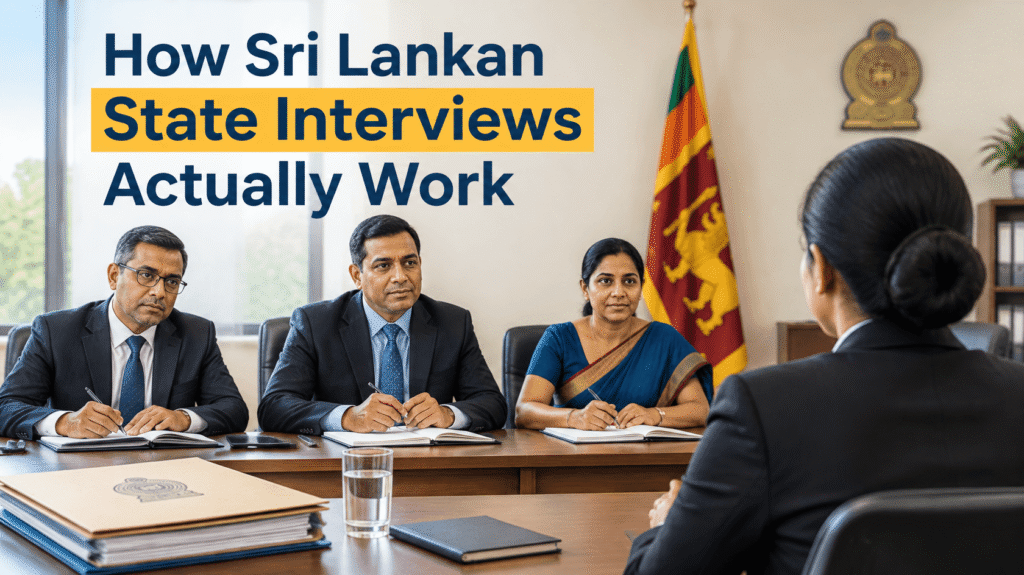
Most government recruitments follow a two-stage interview format, especially for executive and tertiary grades like the Sri Lanka Administrative Service (SLAS), Sri Lanka Scientific Service, or departmental management posts:
- The General Interview (Eligibility Check): Before anyone asks about your leadership style, a verification board checks every original certificate against the closing date of the Gazette notification. If the Gazette required your degree or NVQ Level 4 qualification to be completed by August 10, a certificate dated August 15 disqualifies you immediately. No marks are awarded here; you simply pass or fail eligibility.
- The Structured Interview (Marking Board): Once cleared, you face a three-to-five-member panel—usually senior ministry secretaries, department heads, and a PSC representative. They score you against a predetermined marking scheme covering additional qualifications, subject knowledge, communication, language proficiency, and competency-based questions.
The Mandatory Document File Checklist
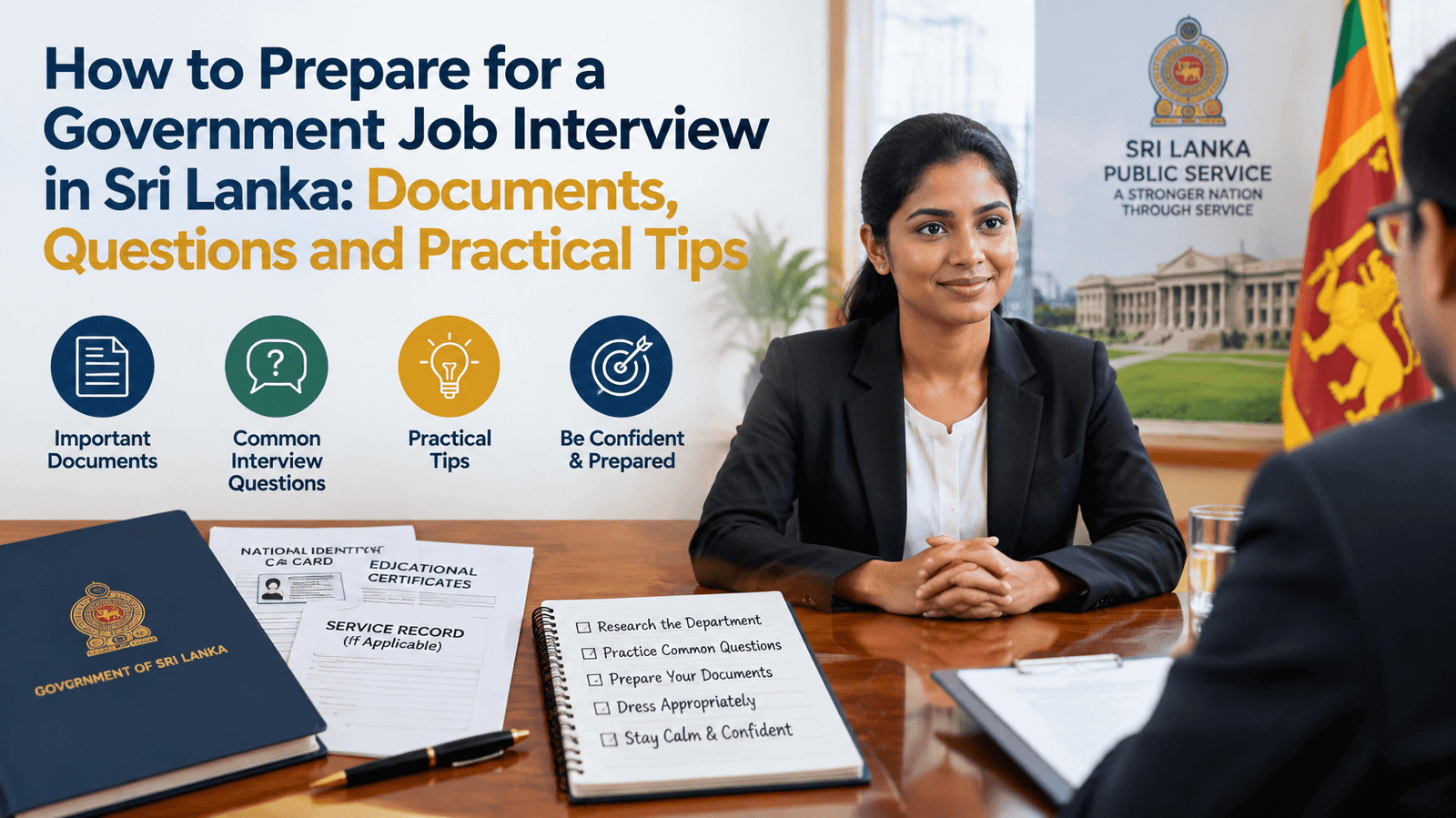
Do not walk into a government interview holding loose papers in a plastic sleeve. Arrange your originals in a clean ring binder or clear-pocket folder in the exact order listed on your interview call letter, alongside a separate set of certified photocopies.
- Interview Call Letter & Exam Admission Card: Keep the original registered-post call letter (or official online download) right at the front, paired with your written exam admission slip if applicable.
- National Identity Card (NIC) or Valid Passport: Check that the lamination is intact and your NIC number matches your application form digit for digit.
- Original Birth Certificate: Ensure it is an official extract issued by the Registrar General’s Department, not a faded school copy.
- G.C.E. O/L and A/L Certificates: Online result printouts are never accepted at final interviews. Obtain official certificates issued by the Department of Examinations well ahead of time.
- Degree Certificate & Detailed Transcript: Bring your original degree scroll (or Senate-approved provisional certificate if convocation is pending) plus the full academic transcript showing your class and effective date. For private or foreign degrees, attach your University Grants Commission (UGC) recognition letter.
- Professional & Vocational Certificates: Include NVQ certificates verified by the Tertiary and Vocational Education Commission (TVEC), or professional memberships (such as CA Sri Lanka, CIMA, or IESL) earned before the Gazette closing date.
- Grama Niladhari Character Certificate: Must be countersigned by the Divisional Secretary and issued within the last six months.
- Service Letters & No-Objection Approval (If Currently Employed): If you already work in a state institution or statutory board, your application and interview appearance must be routed through your current Head of Department.
Common Questions and How to Answer Them
Under modern PSC guidelines, interview boards use a 1-to-7 competency rating scale and expect structured answers using the STAR (Situation, Task, Action, Result) method rather than vague opinions.
1. “How would you handle political or external pressure to bend a procurement rule?”
Panels test integrity and knowledge of the Establishments Code and Financial Regulations (FR). Never say “I would argue with them” or “I would just ignore it.”
Sample Answer: “In public service, every financial decision has to stand up to an Auditor General’s query years later. If someone requested an irregular procurement shortcut, I would first listen politely, then explain the exact Financial Regulation or tender threshold that prevents it. Next, I would document the technical grounds on the official file and escalate the matter in writing to my Head of Department, offering lawful alternatives—such as an emergency procurement route if the criteria genuinely apply—so service delivery continues without breaching rules.”
2. “Tell us about a time you resolved a difficult operational bottleneck.”
Use the STAR framework with a concrete local scenario, whether from a university project, internship, or private-sector job.
Sample Answer: “During my internship at a divisional hospital’s medical supplies unit (Situation), outpatient clinic queues were backing up because manual stock ledgers took two hours every morning to reconcile (Task). I organized the fast-moving essential drugs into color-coded shelf bins and built a simple daily tally sheet that ward nurses signed upon collection (Action). Within three weeks, morning stock verification dropped to twenty minutes, and clinic dispensing started on schedule (Result).”
3. “Why leave a higher-paying private sector career for public service?”
Avoid clichés like “I want to serve the nation” without backing them up. Connect your technical skills to public-sector scale.
Sample Answer: “Working in private logistics taught me how to track supply chains under tight deadlines. However, private firms optimize for single-company profit, whereas a state agency shapes infrastructure and service standards across an entire district. I am ready to trade short-term commercial incentives for the opportunity to apply modern inventory and data tracking to public systems that thousands of citizens rely on daily.”
4. Language & Current Affairs Checks
Many structured interviews award dedicated marks (often 50 to 100 marks out of the interview total) for proficiency in a second official language (Sinhala or Tamil) or English. Expect a board member to switch languages mid-way and ask you to summarize your current job duties or explain a recent national policy—such as digital government initiatives, rural infrastructure programs, or sustainable energy targets—in two or three clear sentences.
Practical Tips for the Day of the Interview
Small details carry heavy weight in traditional Sri Lankan administrative culture.
Dress Code and Appearance
Conservatism wins every time.
- Men: Wear a clean, well-ironed long-sleeved shirt (light blue, white, or muted stripes) with dark formal trousers, a matching tie, and polished black or brown leather shoes. Avoid loud patterns or casual sneakers.
- Women: A neat Kandyan (Osariya) or Indian saree in a muted, professional color remains the gold standard for Sri Lankan government interviews. If you prefer Western formal wear, choose a modest knee-length skirt suit or tailored trousers with a formal blouse and closed-toe shoes. Keep jewelry minimal.
Entering and Addressing the Board
Knock gently, wait for permission, and walk in calmly. Greet the panel with a clear “Good morning, Madam/Sir” or “Ayubowan” depending on the medium of the interview. Do not pull out the chair and sit until the chairperson invites you to do so. Place your document folder neatly on your lap or the designated side desk—never spread your papers across the board’s table.
Language Switching
Many circulars require proficiency in an official language other than your first language within a few years of appointment. Even if your interview is conducted primarily in Sinhala or Tamil, a panelist might suddenly ask a question in English to test your comfort level. Do not panic. If you struggle to express a complex policy point in English, answer clearly in simple, direct sentences rather than trying to use complicated vocabulary and stalling mid-sentence.
Arrive Early and Stay Composed
Government interview centers—whether in Colombo, Kurunegala, or Galle—often call fifty candidates for the same 9:00 AM time slot. You might wait three hours before your name is called. Bring a bottle of water, eat a proper breakfast, and avoid getting drawn into anxious corridor rumors about “who knows whom” or “how tough the third panelist is.” Treat the waiting room as quiet preparation time to review your ministry notes one final time.
Frequently Asked Questions
Can I submit a certificate for a course I finished after the Gazette closing date?
No. Under Public Service Commission procedural rules, all educational and professional qualifications must be fully completed—with effective results issued—on or before the closing date stated in the Gazette notification. Anything earned afterward cannot be counted for eligibility or extra marks, though you may mention ongoing studies briefly if asked about personal development.
What happens if my name is spelled slightly differently on my Birth Certificate and Degree Certificate?
This is very common in Sri Lanka (for example, initials ordered differently or Perera vs. Parera). Before the interview, swear an Affidavit before a Justice of the Peace or Commissioner for Oaths confirming that both names refer to the exact same person, and get it certified alongside your NIC.
Who is allowed to certify photocopies of my documents?
Unless your call letter specifies otherwise, copies can be certified by a Justice of the Peace (JP), an Attorney-at-Law, a Grama Niladhari, a Principal of a government school, or an Executive-grade officer in the public service. Ensure the official rubber stamp clearly shows their name, designation, and registration number.
Find more related information.