
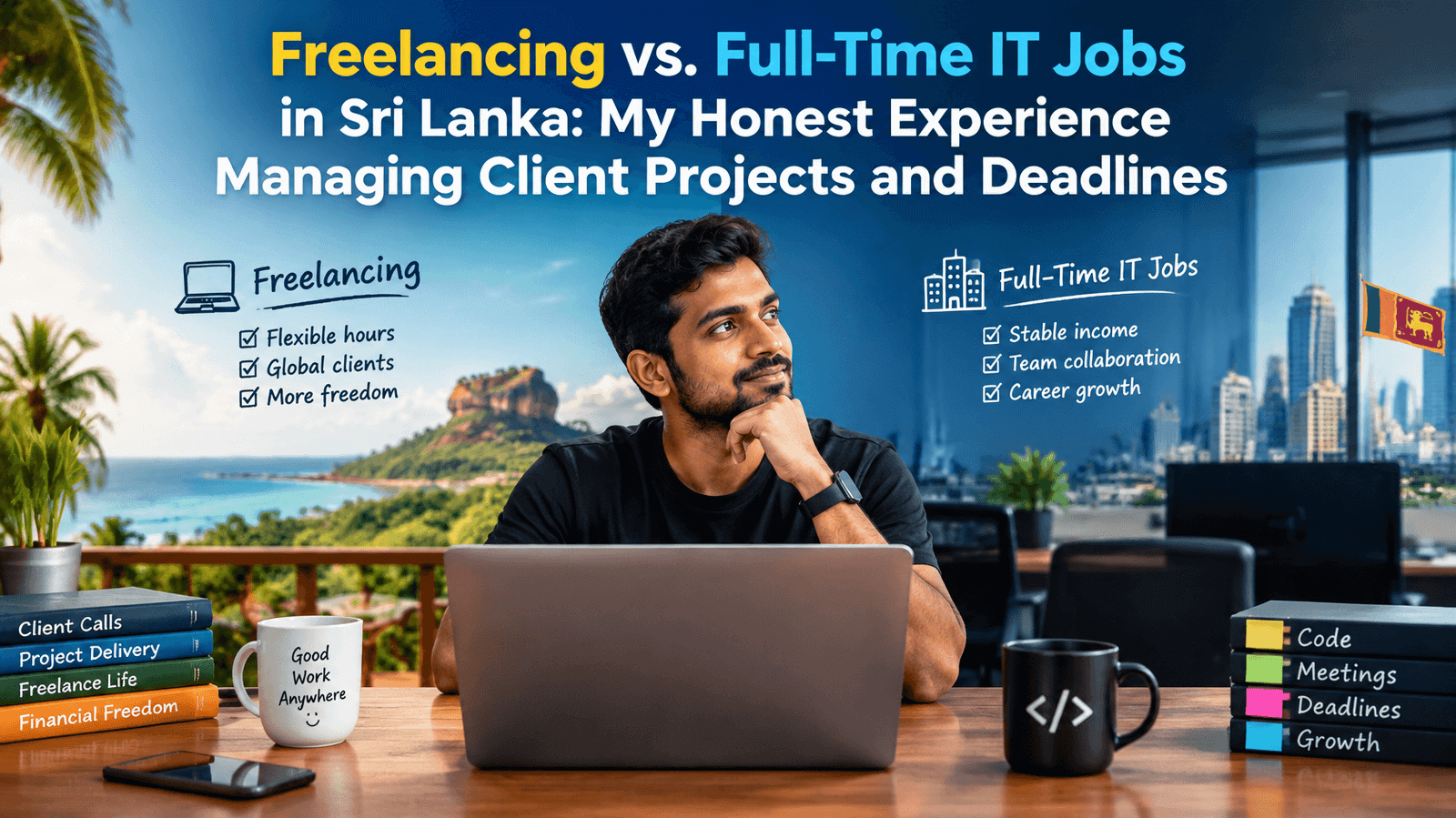
Two years ago, I sat in a Colombo coffee shop staring at two screens. On my left laptop sat a Slack channel from a local enterprise client demanding an urgent patch before their morning board meeting. On my right monitor, a freelancing client in Melbourne had just pushed a payment notification for a custom web application I built over four evenings.
That contrast sums up the reality of Sri Lanka’s tech sector.
Every software developer, systems administrator, and digital consultant in Sri Lanka eventually hits this fork in the road. Do you stay inside the structured safety of a local IT company, or do you bet on yourself and chase foreign currency through independent consulting?
Having worked inside corporate engineering teams and later run my own independent web infrastructure and development projects, I can tell you neither path is effortless. Both carry hidden costs that nobody mentions on LinkedIn.
The Quiet Value of a Local Tech Salary
When people talk about local IT jobs in Colombo or Kandy, they usually fixate on the monthly gross figure. Mid-level software engineers and DevOps specialists at established firms typically earn anywhere from LKR 250,000 to LKR 450,000 a month, while senior architects cross LKR 600,000. On paper, converting that to US dollars can feel discouraging when you compare it to global remote rates.
Yet a formal Sri Lankan employment contract comes with financial armor that freelancers have to build from scratch:
- Statutory Retirement Savings: Under the Employees’ Provident Fund (EPF), your employer contributes 12% on top of your salary while 8% is deducted from your pay. Add the mandatory 3% employer contribution to the Employees’ Trust Fund (ETF), and an extra 15% of your gross income quietly compounds in the background every single month. Teamed.Global
- Predictable Cash Flow: The 25th of the month arrives, and your bank balance updates. You do not chase invoices or worry about a client’s accounting department delaying a wire transfer over a public holiday.
- Paid Leave and Medical Cover: When dengue season hits or a family emergency pulls you away for a week, your income does not stop. Most mid-to-large local tech firms also include family hospitalization insurance, which saves you hundreds of thousands of rupees if something goes wrong.
More importantly, a full-time role protects your boundaries. Once you log off at 6:00 PM, your project manager absorbs the client’s panic. You write code, push your pull request, and sleep.
Chasing USD: The Reality of Independent Consulting
Switching to independent consulting changes your relationship with money overnight. Instead of waiting for an annual 10% increment, a single well-scoped server migration or custom WordPress architecture project for an overseas client can equal two months of local pay.
However, the tax and banking rules around foreign income in Sri Lanka shifted significantly. Prior to April 2025, foreign-currency service exports enjoyed a full income tax exemption.
Under the Inland Revenue Department (IRD) rules effective from the 2025/2026 assessment year, that blanket exemption is gone. Today, if you render IT services to a client outside Sri Lanka, get paid in foreign currency, and remit those funds through a Sri Lankan bank, your tax is capped at a concessionary 15% rate (after your LKR 1.8 million personal relief). Leave your money sitting in an offshore wallet like Payoneer or Wise without remitting it home, and you lose that 15% cap, exposing your earnings to progressive local tax bands up to 36%.
| Factor | Full-Time Local IT Role | Independent Consulting / Freelancing |
|---|---|---|
| Income Ceiling | Capped by local company salary bands | Uncapped; scales with international USD/GBP/AUD rates |
| Retirement & Benefits | 12% EPF + 3% ETF + medical insurance | Zero employer contributions; you must self-fund investments |
| Taxation | Deducted automatically via APIT | Self-assessed; 15% cap on remitted foreign service exports |
| Client Communication | Filtered through team leads and PMs | Direct responsibility for scoping, billing, and revisions |
| Bank Loan Eligibility | High; banks love 6 months of salary slips | Difficult; requires 2+ years of audited accounts and tax filings |
Try applying for a housing loan or vehicle lease at a Sri Lankan commercial bank as a freelancer. Even if you earn triple what a salaried senior engineer makes, credit officers will scrutinize your irregular inward remittances and demand two years of certified tax returns before approving anything.
Managing Client Projects When You Are the Entire Company

The hardest part of freelancing is not technical execution. It is context switching.
When I manage infrastructure migrations, custom database queries, and technical SEO setups for multiple clients simultaneously, coding takes up maybe 50% of my week. The rest goes to writing proposals, configuring staging environments, chasing DNS propagation, and explaining to non-technical founders why a “quick design tweak” breaks mobile responsiveness.
Deadlines hit differently when there is no safety net. A few months ago, a client’s live site experienced an SSL and routing failure right as a regional power cut hit my neighborhood. My fiber router died, my laptop battery sat at 38%, and a client in London was waiting for an update. In an office job, another engineer in Colombo or Kandy picks up the ticket. As a solo consultant, you tether your phone on a shaky 4G connection, spin up a backup hotspot, and fix the DNS records before the battery dies.
Three Habits That Saved My Sanity
If you decide to take on independent projects, standard productivity advice fails quickly. These three habits kept my deadlines intact:
- Price the Risk, Not Just the Hours: Never quote a fixed price based on how fast you can write the code on a good day. Add a 25% buffer for scope creep, third-party API bugs, and client feedback delays.
- Enforce Milestone Payments: Collect 40% to 50% upfront before touching a single line of code or server config. Clients who hesitate to pay a deposit are the exact ones who disappear when the final invoice arrives.
- Separate Production From Communication: Check emails and messages twice a day—once at 10:00 AM and once at 4:30 PM. Keeping Slack or WhatsApp open all day turns you into a reactive support desk instead of a problem solver.
Which Path Makes Sense for You?

You do not have to treat this as a permanent, all-or-nothing identity.
If you have fewer than three years of commercial experience, stay in a strong local engineering team. Learning how senior architects handle production outages, code reviews, and large-scale deployments gives you credibility that no online course can replicate. Use your evenings to build one or two small side projects—not for the money, but to learn how to scope work and talk to clients.
Once you have built an emergency fund covering at least six months of living expenses, and you have two recurring international clients who trust your work, transitioning to full-time consulting stops feeling like a gamble. Freedom in tech does not come from quitting your job.
It comes from building enough financial buffer and operational discipline that you never have to accept a bad client just to pay next month’s bills.